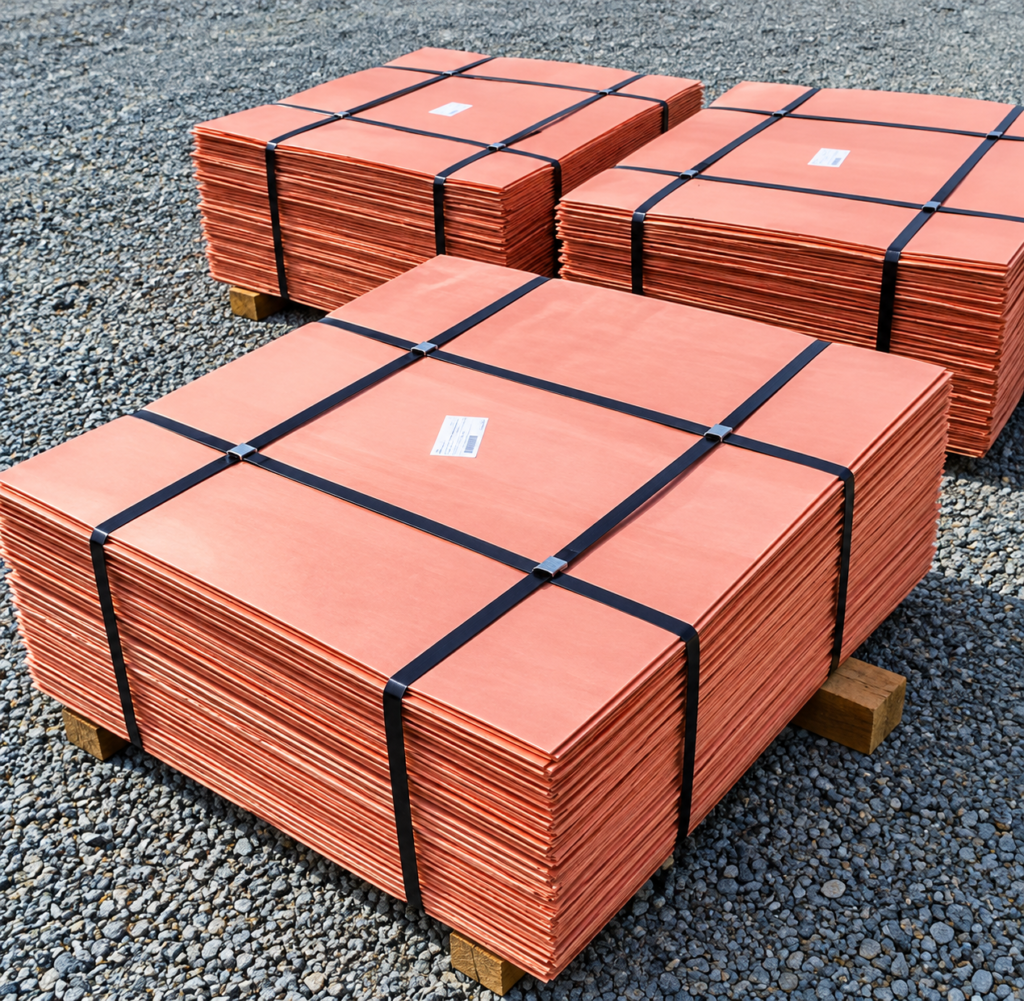
Copper Cathodes for Industrial and Commercial Applications
Copper Cathodes are high-purity refined copper products produced through an electrolytic refining process. They are commonly supplied in flat plates or sheets and serve as an important raw material for manufacturers, fabricators, wire producers, cable manufacturers, and other industrial users.
Because refined copper provides excellent electrical and thermal conductivity, corrosion resistance, ductility, and recyclability, the are widely used throughout the global copper supply chain.
What Are Copper Cathodes?
The are the refined copper plates obtained after copper ore or intermediate copper products undergo concentration, smelting, converting, and electrolytic refining.
During electrolytic refining, copper is deposited onto cathode starter sheets or permanent cathodes. The resulting refined copper plates can then be removed, inspected, bundled, and supplied to manufacturers for further processing.
Commercial copper cathodes are commonly associated with very high copper purity, although the exact grade and chemical composition should always be confirmed through official product documentation.
Copper Cathodes Purity
Purity is one of the most important characteristics of Copper Cathodes. High-purity refined copper is required for applications where consistent conductivity and controlled chemical composition are essential.
Commercially traded copper cathodes are commonly produced to recognized industry specifications, with high-purity grades generally containing around 99.99% copper.
The exact purity, trace-element limits, and grade should be verified through the supplier’s certificate of analysis and applicable product standard.
Technical Specifications
| Specification | Typical Information |
|---|---|
| Product | Copper Cathodes |
| Chemical Symbol | Cu |
| Atomic Number | 29 |
| Material | Refined Copper |
| Typical Purity | Approximately 99.99% Cu for common high-purity grades |
| Form | Flat Plates / Cathode Sheets |
| Appearance | Reddish-orange metallic |
| Melting Point | Approximately 1,085°C |
| Density | Approximately 8.96 g/cm³ |
| Electrical Conductivity | Very High |
| Thermal Conductivity | Very High |
| Production Method | Electrolytic Refining |
| Packaging | Bundled / Strapped / Palletized |
| Primary Applications | Wire, Cable, Electrical & Industrial Manufacturing |
Actual specifications can vary according to the producer, grade, certification, and shipment. Buyers should verify the precise specification before purchase.
Applications
It are primarily used as feedstock for producing a wide range of copper products. They can be melted, cast, rolled, drawn, or processed into different shapes and products.
Common applications include:
- Copper wire production
- Electrical cable manufacturing
- Electrical conductors
- Busbars
- Copper sheets and plates
- Tubes and pipes
- Copper rods
- Industrial components
- Copper alloys
- Construction materials
- Engineering products
Wire and Cable Manufacturing
One of the major applications of it is the production of copper rod, wire, and electrical cable.
High-purity copper is particularly suitable for electrical applications because of its excellent conductivity. Copper cathodes can be melted and continuously cast into copper rod before being drawn into different wire sizes.
This makes refined copper cathodes an important raw material for electrical and telecommunications supply chains.
Electrical Applications
The electrical industry relies heavily on high-quality refined copper. Its combination of electrical conductivity, ductility, thermal performance, and durability makes it suitable for numerous electrical products.
It can be processed into:
- Electrical conductors
- Power cables
- Transformer components
- Busbars
- Motors
- Generators
- Electrical contacts
- Wiring systems
Construction and Manufacturing
Copper is also widely used in construction and industrial manufacturing. Its corrosion resistance and thermal conductivity make it useful for plumbing, heating, cooling, roofing, and engineering applications.
Refined Copper Cathodes can be converted into sheets, tubes, rods, wires, and other semi-finished copper products according to manufacturing requirements.
Quality and Verification
Quality control is essential when purchasing refined copper. Buyers should review the cathode’s purity, chemical composition, dimensions, weight, manufacturer, production information, and certification.
A certificate of analysis can provide information about copper content and controlled impurity levels. For significant commercial transactions, independent inspection or laboratory testing may also be appropriate.
Buying Copper Cathodes
When sourcing Copper Cathodes, buyers should consider:
- Copper purity
- Grade and applicable standard
- Cathode dimensions
- Individual bundle weight
- Total quantity
- Producer or refinery
- Certificate of analysis
- Packaging and strapping
- Loading arrangements
- Destination
- Delivery terms
- Required documentation
Clear specifications help buyers and sellers establish whether the material is suitable for the intended application.
Copper Cathodes
Wholesale Copper Cathodes are commonly traded in substantial quantities for industrial processing and manufacturing. Buyers may require specific purity levels, packaging formats, quantities, certificates, and delivery arrangements.
For a commercial quotation, buyers should specify their required quantity, grade, destination, preferred packaging, and documentation requirements.
Benefits,
High-quality Copper Cathodes provide several advantages as an industrial raw material:
- Very high copper purity
- Excellent electrical conductivity
- Excellent thermal conductivity
- Good ductility
- Good corrosion resistance
- High recyclability
- Suitable for further processing
- Broad industrial applications
These characteristics make refined copper cathodes an important material within the global copper supply chain.
Conclusion
Copper Cathodes are high-purity refined copper plates used as a fundamental raw material in electrical, cable, construction, engineering, and manufacturing industries. Their high copper content and excellent conductivity make them particularly valuable for producing copper rods, wires, cables, sheets, tubes, and other semi-finished products.
When purchasing copper cathodes, buyers should carefully verify purity, grade, chemical composition, producer information, certification, quantity, packaging, and delivery requirements. Proper documentation and material verification help ensure that the supplied copper meets the technical requirements of the intended application.