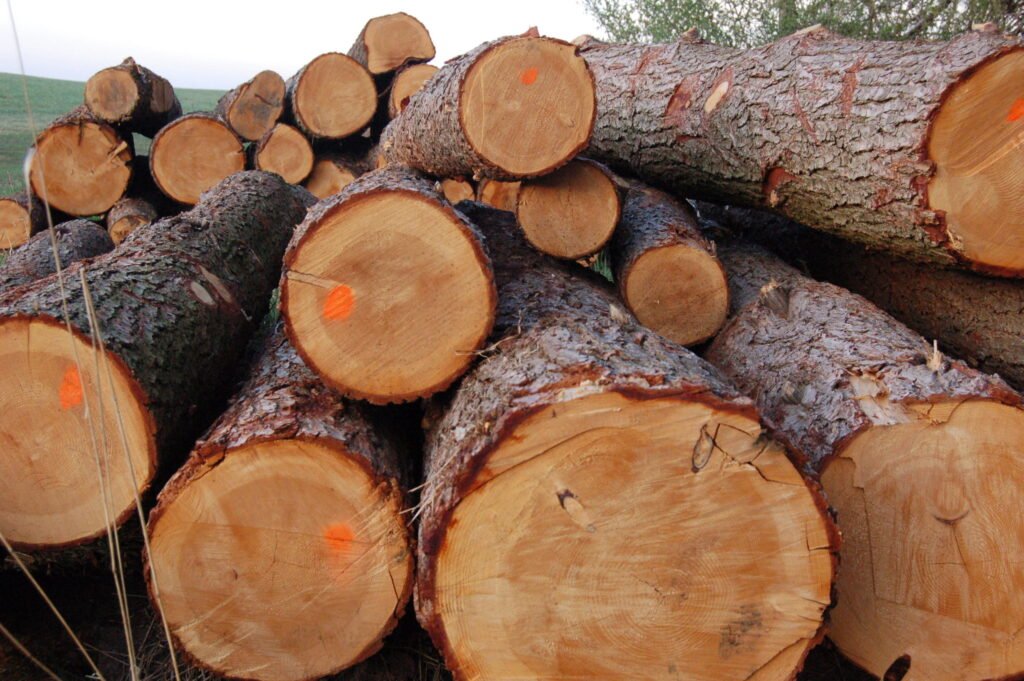
Hemlock Wood Logs
Hemlock Wood Logs are versatile softwood timber products valued for their relatively uniform grain, light colour, workability, and suitability for a wide range of woodworking and construction applications. Hemlock timber is commonly associated with species from the Tsuga genus, including Western Hemlock and Eastern Hemlock.
Depending on the species, origin, grade, and growing conditions, hemlock timber can vary in colour, density, strength, moisture content, and appearance. Proper grading and sorting allow buyers to select logs appropriate for construction, joinery, furniture, packaging, interior applications, and general woodworking.
What Are Hemlock Wood Logs?
Hemlock Wood Logs are round timber sections obtained from hemlock trees. Hemlock is a softwood species commonly found in North America and other regions where suitable growing conditions exist.
The wood is generally light in colour and has a relatively straight grain. It can be sawn, machined, planed, drilled, and finished for a variety of commercial applications.
Appearance and Grain of Hemlock Wood Logs
Hemlock timber generally has a pale appearance, ranging from light brown and cream to reddish-brown depending on the species and part of the tree.
The grain is commonly straight and the texture is generally fine to medium. Growth-ring patterns can provide a clean, natural appearance that is suitable for both structural and decorative timber products.
Technical Specifications of Hemlock Wood Logs
| Specification | Typical Description |
|---|---|
| Product | Hemlock Wood Logs |
| Wood Type | Softwood |
| Common Genera | Tsuga |
| Common Species | Western Hemlock, Eastern Hemlock |
| Colour | Cream, pale brown to reddish-brown |
| Grain | Generally straight |
| Texture | Fine to medium |
| Density | Varies by species and moisture content |
| Moisture | Fresh, air-dried or kiln-dried |
| Form | Round logs |
| Length | Variable according to supply |
| Diameter | Variable according to log grade |
| Processing | Sawing, planing, machining and turning |
| Applications | Construction, joinery, furniture, packaging and woodworking |
Specifications vary according to species, origin, grade, dimensions, and moisture condition.
Properties of Hemlock Wood Logs
Hemlock Wood Logs offer several characteristics that make them useful for commercial timber processing:
- Light natural colour
- Generally straight grain
- Fine to medium texture
- Good workability
- Suitable for sawing and machining
- Can provide a smooth finished surface
- Suitable for various construction applications
- Useful for interior and general woodworking
The exact mechanical and physical properties should be confirmed according to the species and timber grade.
For Construction
Hemlock timber is used in various construction and building applications where appropriately graded material is required. Processed timber may be used for framing, boards, structural components, interior construction, and other building products.
For load-bearing applications, the timber should meet the relevant structural grade and standards required in the destination market.
For Joinery and Woodworking
Hemlock Wood Logs can be converted into boards, planks, mouldings, frames, and other components used in joinery and woodworking.
Its relatively consistent grain and workable characteristics make it suitable for machining, cutting, drilling, planing, and finishing.
For Furniture and Interior Applications
Selected hemlock timber can be used for furniture components, shelving, interior trim, doors, panels, mouldings, and other indoor products.
The naturally light colour of hemlock provides a neutral appearance that can be left natural or modified using stains, paints, coatings, and other finishing treatments.
Hemlock Wood Logs for Packaging
Hemlock timber may also be processed into packaging materials and other timber products where suitable grades and dimensions are available.
Depending on buyer specifications, logs can be sawn into boards, blocks, battens, or other forms for commercial packaging requirements.
Processing,
Hemlock Wood Logs can be processed through several stages:
- Inspection – Logs are examined for dimensions, defects, damage, and overall condition.
- Sorting and grading – Material is separated according to size and quality.
- Debarking – Bark may be removed depending on the intended application.
- Sawing – Logs are converted into boards, planks, beams, or other timber products.
- Drying – Timber may be air-dried or kiln-dried according to requirements.
- Machining and finishing – Processed timber can be planed, sanded, shaped, or finished.
Quality Requirements for Hemlock Wood Logs
Commercial buyers may assess Hemlock Wood Logs based on:
- Exact species
- Country and region of origin
- Log length and diameter
- Straightness
- Moisture content
- Knots
- Cracks and splits
- Resin pockets
- Insect or fungal damage
- Colour and grain
- Overall timber grade
- Required documentation
Clear grading specifications should be agreed before bulk purchasing.
Sourcing Hemlock Wood Logs
When sourcing Hemlock Wood Logs, buyers should request details covering species, origin, dimensions, grade, moisture condition, quantity, packaging, and available documentation.
For international shipments, buyers should also confirm applicable forestry, phytosanitary, import, export, and timber-trade requirements.
Sustainable Timber Sourcing
Responsible sourcing is important when purchasing natural timber. Buyers should verify the legal origin of Hemlock Wood Logs and request appropriate documentation where required.
Depending on the country of origin and destination, requirements may include legality verification, forestry documentation, traceability information, and phytosanitary certification.
Hemlock Wood Logs for Wholesale Buyers
Hemlock Wood Logs can be sourced for sawmills, timber processors, construction suppliers, furniture manufacturers, joinery businesses, packaging producers, and woodworking companies.
For wholesale transactions, buyers should specify the required species, dimensions, grade, moisture content, quantity, loading method, and destination requirements.
Why Choose Hemlock Wood Logs?
Hemlock Wood Logs are valued for their:
- Light and natural appearance
- Generally straight grain
- Fine to medium texture
- Good workability
- Versatile processing characteristics
- Suitability for construction and joinery
- Use in furniture and interior applications
- Availability in different grades and dimensions
Conclusion
Hemlock Wood Logs are versatile softwood timber products suitable for construction, joinery, furniture, packaging, interior applications, and general woodworking. Their light colour, workable characteristics, and generally straight grain make them useful for a broad range of commercial timber products.
For bulk purchasing, buyers should confirm the exact species, origin, dimensions, grade, moisture content, quality requirements, and applicable legal or trade documentation before shipment.